


Scotland: the Founding and Revival of a Historic Black Community
- Jun 1
- 9 min read
Updated: Jun 3
Montgomery County, Maryland
by Neile Whitney

Scotland is one of the most well-known historic Black communities in Montgomery County. When Scotland began, most of Montgomery County was still composed of farms, large and small.
In the aftermath of the Civil War, with the loss of free labor by the enslaved, landowners began to sell off parcels of land. Usually, the land sold to Black residents was the least desirable for farming. The community was known until the 1920s as “Snakes Den,” because that was the name of the original draft (parcel) of land, which was known for its rocky terrain and dens of snakes. The name “Scotland” may have been taken from a nearby property and replaced the “Snakes Den” moniker.
At its peak, Scotland, with 500 acres, was not only the largest community in the county, but was also known for its long struggle as pressures by developers and the county tried to condemn (1) family homes and buy their land. Scotland is a story of survival in the midst of the “urban development” pressures of the 1960s and 1970s, which threatened to erase the community entirely.
Eighty years before this struggle began, the first 36.25 acres were sold to William Dove in 1880. More Black families started buying land, eventually owning almost four miles along both sides of Seven Locks Road, not far from what is now Montgomery Mall in Bethesda. Forty-four and one-half acres were purchased in 1883 by James W. Harris (formerly enslaved by Dr. Nicholas Brewer of Dickerson, MD). Other families, including the Masons, Burleys, Wallaces, and Lyles, moved in up and down what was then Cabin John Road (Levine 2000, p. 125), and would later become Seven Locks Road. At least one of the buyers, Henry Dove, served in the 37th Regiment of the United States Colored Troops.

Like other Black communities in the county, Scotland/Snakes’ Den prioritized housing, church and schools. As they first began to build homes, they held school and church services in their homes. Then as they were able to raise money, they built a church, and then classes would often be held there.
Education
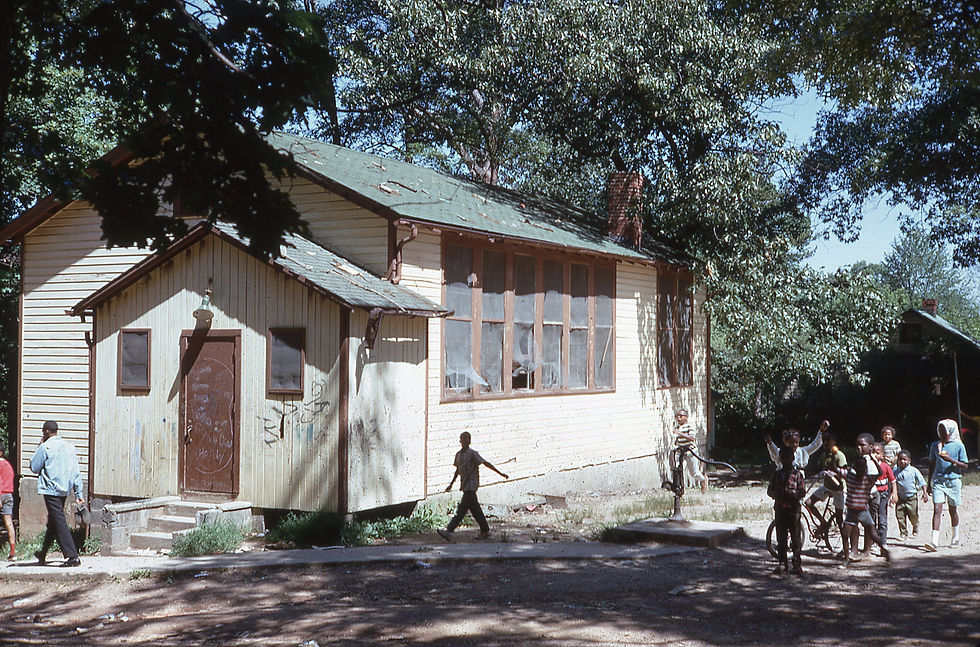
Initially, Scotland children attended the Seven Locks Colored Elementary School, north of Scotland. In 1927, two acres were sold to the county by the Mason family for the school. Scotland then raised $500 that was matched by the Rosenwald foundation for a new one-room schoolhouse. (One and two-room schoolhouses were common in the U.S. at the time.) Children attended that school until integration in the late 1950s. The building was torn down during redevelopment of the community in 1968.
Community Renewal
Like most of the historic Black communities formed post-Emancipation, members of the then “Snakes Den” community worked jobs such as farmhands, domestic servants, day laborers and cooks. But as the county aggressively pushed development by white communities, and as agriculture started to disappear in the lower part of the county, Scotland’s residents found work as day laborers, trash collectors, maids, seamstresses and golf caddies.


(Left) Log cabin slave quarters, one story with loft. Dickerson, MD. Courtesy, Library of Congress. (Brostrup After 1933) (Right) Child playing, water pump, house. 1968 photo by Alan Seigel, courtesy of Montgomery History
Using the skills passed down by their ancestors and practiced as enslaved people, families built simple homes, often with the help of relatives and neighbors, usually one-story with one or two rooms. The home would have a loft under the roof where the children would sleep, accessed by a ladder or steep staircase from the first floor. (2) Early homes were made of logs (photo above, left), may have had a floor of hard-packed earth made from a mixture of dirt and mud from a nearby stream, and had either no windows or one or two windows protected by shutters. (McDaniel 1982, p. 81) This style of home was typical for many settlers of the time: for some of the first residents of Snakes Den, this would have been the first time they had lived in a home that belonged to them.
Over time, the log cabins (photo above, left) wore away and were replaced by plank homes with glass windows, and stone or concrete block foundations (photo above, right). Plank floors replaced dirt floors. Open fireplaces were replaced by potbelly stoves, and then by woodstoves, allowing women to stand up as they cooked instead of bending over. Stoves also had the advantage of being banked (3) at night, keeping the house warmer on cold nights. Wells were dug with pumps for the community, although streams with sweet water were still used. Outhouses were dug and shared by the community.

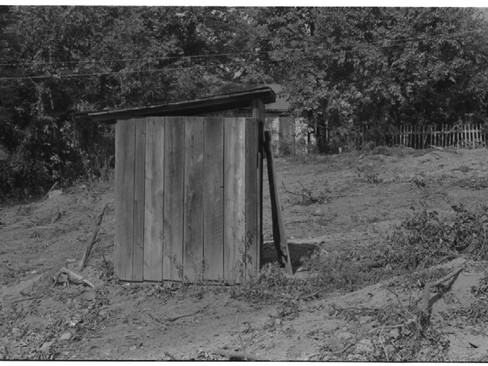


Scotland outhouse (left) and water pump (right) in 1968. Photos by Alan Seigel, courtesy of Montgomery History.
Two-story homes, with two rooms up and two down, were rare in Scotland. Into the 1960s, few homes had electricity, none had running water or a sewer line, and the community had no paved roads and no trash pickup, even after the county had provided them for nearby white communities.
I ended up being raised by—with 13 kids in one house, you know what I mean? It wasn't easy. You had to tote your own water from a spring. You had to chop your own wood. And you had—we didn't have a fireplace, we had a coal stove. We had an oil stove until the latter part of the year. When I was in high school, my father and mother had a furnace installed in the floor, and that was a blessing because after that, I didn't have to chop any more wood. ~ 83-year-old Edgar Dove (Dove 2018)
By the 1960s, many of the once-new homes built by families were worn and patched, the Rosenwald school had aged, and the county wanted a large piece of Scotland for the creation of Cabin John Regional Park, which runs along Cabin John Creek.
The development of white suburbs was pushing upward into the county, putting pressure on Black communities like Scotland, Lyttonsville, Emory Grove, and Stewartown. In all these communities, some families sold their properties to developers or to the county. The county threatened to condemn other homes – to take them by eminent domain and knock them down.
An interim report issued on December 15, 2025, by Montgomery County’s Office of Human Rights of an investigation of urban renewal into nearby Emory Grove, notes that in the 1960s, Montgomery County government began using federal urban renewal policies – with accompanying applications for federal funding – to identify and remedy “blighted” areas. The report states, “Emory Grove was designated as an urban renewal area in the mid-1960s. County records indicate that the lack of piped water and sewer service, housing conditions, and development pressures were central justifications for this designation.” So the absence of water and sewer service – a direct result of government policy – was cited as a reason for “renewal.” (Office of Human Rights, Montgomery County, MD 2025)
Many of Scotland’s landowners sold their tracts of land because of what seemed to be generous offers (but Scotland descendants now note were often only a fraction of their worth), and because of concerns that their homes could end up condemned. By 1965, there were about 48 acres left of the original 500. Twenty-three of the 35 remaining homes had been condemned. (Levine 2000, p. 129) Some of the family wells were unusable, and the community well had a broken pump. A new development nearby was planning on destroying the stream that supplied much of the Scotland community’s water.
Just as community members were ready to give up their fight against the destruction of what was left of the historic community, a group of residents, including community activists Geneva Mason, Melvin Crawford, Sr., and Bette Thompson, were joined by a local white resident named Joyce Seigel. Together they formed “S.O.S.” (Save Our Scotland), to work together to push back against county plans to condemn the remaining housing and relocate residents, and instead create plans for better living conditions for the residents. They were joined by local volunteer organizations, and together, a coalition of Black, white, Christian, Jewish, and Baha’i members surveyed the challenges that Scotland was facing and created a plan moving forward.
Some of the first efforts included convincing the county to put in a sewer line as far as the Scotland A.M.E. Church, to create some educational programs for the children, and to draw community members to meetings by the Planning Board to petition for the end of efforts to buy the rest of the land in Scotland by the county. Then the board and volunteers of S.O.S. worked to create a plan to build improved housing for community residents.


Building the new townhomes at Scotland in 1968. Photos by Alan Seigel, courtesy of Montgomery History
In 1975 a community center was completed, and was named after Bette Thompson. The center offers a basketball court, a gym, a social hall and more for the community to use.
After years of use, both the rental townhomes and the community center have been renovated in recent years. Some of the descendant Black families have moved out and the community has become more diverse. But descendants of the founding families remain, and many more are scattered throughout the county and the DMV.
The work of Save Our Scotland provided a template of how to resist efforts by the county to push out Black neighborhoods and to bring in more white suburbs. It preserved what was left of a historic kinship community, built of and by families who have lived in the county for generations. It pressured the county to offer the same services to the Scotland community that it had long-ago offered to white communities – services that improved everyone’s lives, including water, electricity, sewer, trash pickup and street lights. It created a forum for local white and Black communities to work together toward a common cause.
It also provided a model for successful recent work to save and restore Scotland’s church when it was badly damaged in 2019 by floods. Through the church’s “2nd Century Project,” guided by LaTisha Gasaway-Paul, the great-great--granddaughter of founder William Dove, the group raised $11 million dollars to restore and expand the church.


(Left) Renovated Scotland AME Church. Photo by Neile Whitney (Right) Ribbon cutting at Scotland Zion. Pictured from left to right: Bob Buchanan, Congresswoman April McClain Delaney, County Executive Marc Elrich, LaTisha Gasaway-Paul, Michelle Dove, Alan Heard, Reverend Dr. Evalina Huggins, Councilmember Evan Glass. Behind: Various members of the Montgomery County Council and the community. Photo by Clark Day
In April of 2025, Scotland celebrated the restoration of the church with a ribbon cutting. After years of raising funds from generous donors, and many hours of work by volunteers, the group celebrated the return of a building that had long been the heart of the community.
Once threatened with extinction by creeping development, redlining and racial covenants, the descendants of William Dove and other founders now offer this space to people of all faiths for church services, Sunday school, and youth programs. The Scotland community continues its ongoing efforts to advance a vision that includes affordable housing, community gardens, early learning facilities, and a heritage center.
Footnotes
To condemn a residence is to deem it unfit or unsafe for human habitation. This could be because the inspector felt it was dilapidated, or because it “lacks, entirely or partly, illumination, ventilation, heating, water supply, or sanitation facilities….” (Montgomery County, Maryland 2025)
An example of this type of building, from the Jonesville community in Pooleville, can be found at the Museum of African-American History and Culture in Washington, DC.
Banking a fire involved letting the fire burn down to coals, pushing the coals together and covering them with a light layer of ash. A banked fire would maintain warmth for several hours, or even through the night, and would not have to be relit in the morning.
------------------------------------------
With thanks to LaTisha Gasaway-Paul and Delianny Brammer of Scotland for their assistance proofing and fact-checking this article.
References
Cornell Law School. 2018. “Eminent Domain.” LII / Legal Information Institute. Cornell Law School. November 13, 2018.
Deppisch, Breanne. 2016. “Bette Thompson, Activist Who Helped Transform Black Md. Enclave, Dies at 80.” The Washington Post. February 5, 2016. https://www.washingtonpost.com/local/bette-thompson-activist-who-helped-transform-black-md-enclave-dies-at-80/2016/02/05/88adbde8-cb66-11e5-88ff-e2d1b4289c2f_story.html
Dove, Edgar. 2018. “Oral History of Edgar Dove,” Shares his life experiences growing up mid-century in the Montgomery County community of Scotland: living conditions, segregation, education, job opportunities, and family life. Montgomery History.
Elrich, Marc, James Stowe, and Office of Human Rights, Montgomery County, MD. 2025. “Interim Report Submitted by the Emory Grove Task Force,” How the Urban Renewal Program Carried out between 1960 and 1985 Led to the Displacement of Residents of the Historically Black Community of Emory Grove.” Montgomery Perspective. https://montgomeryperspective.com/wp-content/uploads/2025/12/Interim-Report-and-Findings-Submitted-by-the-Emory-Grove-Task-Force-December-2025.pdf
Gasaway-Paul, LaTisha, Roosevelt Twyman, and Paul “Boo Boo” Palmer. 2024. Swindled out of their land, but still standing: Maryland’s Scotland community is rich with history Interview by Lesli Foster. https://www.wusa9.com/article/life/holidays/black-history-month/african-american-scotland-community-montgomery-county-maryland/65-322431b6-3ed7-4825-bf6f-0621e70ed63f?fbclid=IwY2xjawQmkbZleHRuA2FlbQIxMQBicmlkETFUNzNwSExCTU1MMWVpVTdVc3J0YwZhcHBfaWQQMjIyMDM5MTc4ODIwMDg5MgABHunzWt1DlnyBx_8RBJUSnk5VbK_sh7P9zppTPRnec4aB-1R-Z-dFLsfZNo2c_aem_rsgnEkXDOz479o40aBeYTQ
Griffin, Elia. 2025. “New Beginnings: Historic Black Church in Potomac Celebrates Rebuilt Facility.” Bethesda Magazine. May 1, 2025. https://bethesdamagazine.com/2025/05/01/new-beginnings-historic-black-church-in-potomac-celebrates-rebuilt-facility/
Holden, Dr. Patrise. 2025. “Standing on Legacy, Rising to New Beginnings: Scotland A.M.E. Zion Church Celebrates Historic Restoration.” The Washington Informer. May 5, 2025. https://www.washingtoninformer.com/scotland-am-e-zion-church-ribbon-ceremony/
Levine, Harvey A. 2019. “The Resurrection of Scotland.” The Montgomery County Story, May 2019. https://web.archive.org/web/20190619200802/https://montgomeryhistory.org/pdf/43-2.pdf
Montgomery County, Maryland. 1965. Sec. 26-13. Designation of unfit dwellings and unsafe nonresidential structures; condemnation. American Legal Publishing. Montgomery County, Maryland Government. https://codelibrary.amlegal.com/codes/montgomerycounty/latest/montgomeryco_md/0-0-0-134950
Pagnucco, Adam. 2026. “How Montgomery County Government Dismantled a Black Community - Montgomery Perspective.” Montgomery Perspective. January 5, 2026. https://montgomeryperspective.com/2026/01/05/how-montgomery-county-government-dismantled-a-black-community/
This article is part of MoCoLMP's project mapping our historic Black communities and their relationship to sites of enslavement during the Civil War. The map also shows the locations of the three known lynchings in 19th century Montgomery County, MD.


Comments